On Saturday, October 13, I had the opportunity to photograph the cotton farming industry in the eastern Arkansas town of Marked Tree. The cotton belt extends over much of the American South, and the soil along the Mississippi River is especially fertile due to frequent flooding. The hot climate also contributes to good cotton growth.
Cotton farming, of course, has a torturous history in the American South. Until the introduction of greater mechanization, it was a labor-intensive crop, requiring handpicking as well as the removal of seeds and debris by hand. When Eli Whitney introduced the first cotton gin in the early 1800’s, it only intensified the “need” for slave labor in the South. The “gin,” short for “engine,” was a machine that mechanically removed the seeds from the cotton, thus eliminating the need for hand-seeding. With the elimination of hand-seeding, cotton became a much more profitable crop; and since cotton was still handpicked, this intensified the “need” for slave labor in the fields to pick the expanding acreage of cotton.
Between the end of the American Civil War and the 1940s, much cotton was still grown and harvested by hand through the complex system of sharecropping – a system that at best produced a meager existence for sharecroppers and at worst was deeply exploitative of poor white and black folks. Dorothea Lange photographed extensively in this area of Arkansas, documenting the poor conditions of white and black sharecroppers. Many of these photographs were suppressed and never published because they highlighted racial injustice. The Farm Security Administration wanted to present the farming problems of the Great Depression as an exclusively economic issue. Race was simply too dangerous even for Roosevelt’s New Dealers to touch publicly. Beginning in the years following World War II, sharecropping died out with the introduction of more comprehensive mechanized farming and advanced crop growing methods and technologies (cotton pickers, herbicides, pesticides, etc.)
This photo essay was made possible by a friend of mine, Woody Ray, who is a native of east Arkansas and farm manager for E. Ritter & Co. in east Arkansas. I am grateful for his generosity in taking an entire day to tour me (along with a small group of photographer friends) through cotton country. It’s a good thing that Woody is himself an avid photographer. I also wish to thank the employees of E. Ritter & Co. for allowing us this glimpse into their work and way of life.
Here in the Mississippi River Delta, the particular variety of cotton grown is Upland cotton. Upland cotton represents about 95% of the cotton grown in the US. The other type of cotton grown elsewhere in the US is Pima cotton, a longer fibered cotton that provides softer, more luxurious textiles. Below is a boll of Upland cotton that has its harvest-ready fiber exposed. Cotton plants are perennials though they are farmed as if they were annuals in the interest of economic efficiency. Cotton is a tropical plant closely related to hibiscus and okra.
During typical years, each acre of cotton produces about two bales of cotton. If a farmer has an unusually good crop, he/she may get three bales per acre.

Cotton requires a great deal of water to grow, and the drought that has affected the US in recent years has left farmers more dependent than ever on well-based irrigation to ensure that their crops produce. Notice that this plant has already been defoliated in preparation for harvesting. Defoliation once relied on Agent Orange and other leaf-burning chemicals that were applied by cropduster aircraft. Now the chemical used penetrates the cellular structure of the plant and targets the connection point between leaves and stock, weakening it. As the leaves dry, they fall off at this joint. These newer defoliants are often applied with ground-based equipment rather than by cropduster aircraft.

Cotton is harvested by pickers such as this one. This is an older model that still requires the cotton to be dumped from the basket into a trailer to be hauled to the gin. The latest models not only pick the cotton but prepare it more thoroughly for ginning, thus eliminating the need for two or three laborers to handle the cotton prior to arrival at the gin. This older John Deere model costs about $450,000; the newer models cost closer to $750,000. All pickers are used for only about ten weeks per year.

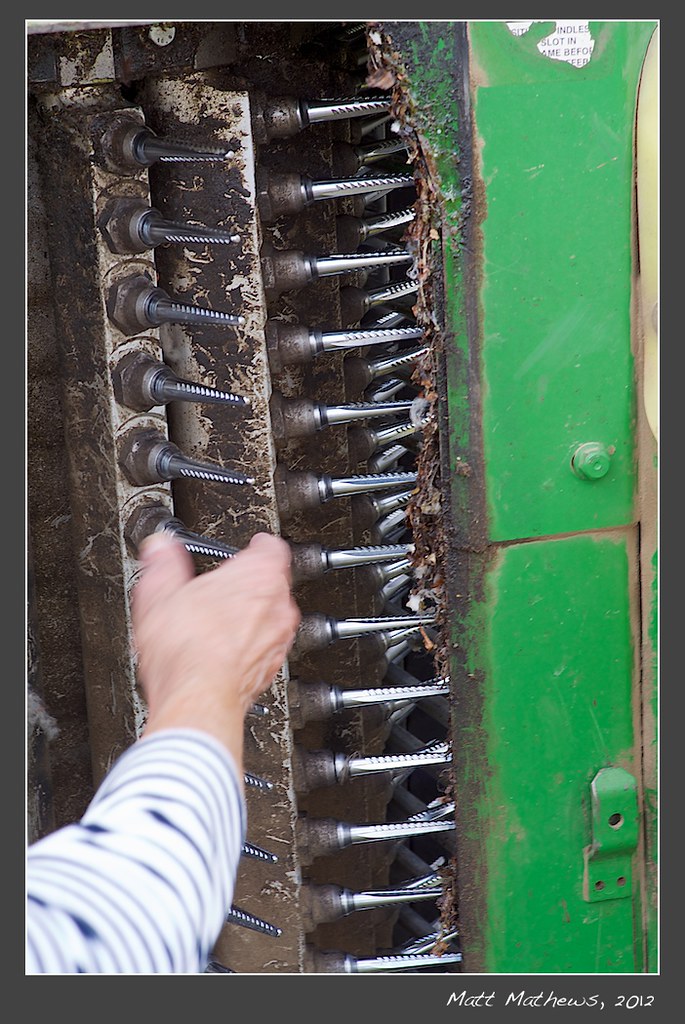
The operator of this picker had to stop to make an adjustment on his machine, so he beckoned us into the field for a quick tour of the machine. The picker drives over the cotton plants and blows the cotton into the picker where the fiber is grabbed by these long barbed pins and carried up into the storage compartment. While design changes have now made these pickers much safer, they are still quite dangerous. Many a farmer has lost a limb, hand, fingers, or their life by being pulled into the picker through these belt-driven barbed pins. The traumas are gruesome. My mother, worked as an ER nurse in rural California and recalls many terrible cotton picker related injuries and fatalities.
Once picked, the cotton is transported to gins such as this one. Cotton gins traditionally process the cotton from the fields of the farmers who own them as well as from the fields of other area farmers. The basic financial arrangement is that a farmer brings his/her cotton to the gin, and it is processed at no direct cost. The gin keeps the seeds and debris byproducts that it then sells for a profit. Currently, the global cotton market is quite depressed as a result of the general global economic downturn. My host told me that there is currently about 50% too much cotton in the global market and that cotton prices have fallen so dramatically that many farmers are resistant to planting cotton next year. As an incentive, the gins may offer to pay them to grow cotton. Most gins operate 24 hours a day/7 days a week during the 2-1/2 months that they are open each year. Typically, this gin produces about 1000 bales per day.

Ginning does three things to the cotton. First, it removes the seeds from the fiber (called “lint”). Second, it cleans the lint by removing sticks, leaves, and debris caught in it; and finally, it compresses the lint into bales for storage and transportation to textile manufacturers.
While modern gins are much safer places than their earlier counterparts, there are still dangers, and workers and customers are warned accordingly.

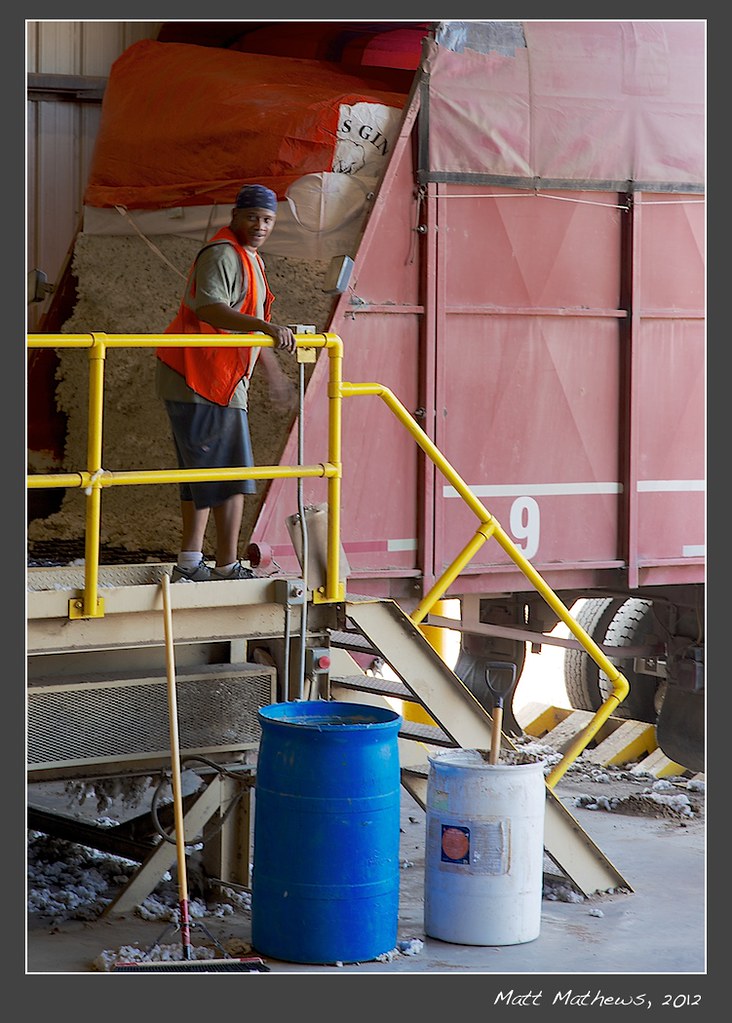
Cotton arrives by truck from the field and is backed into one side of the gin building. The cotton is then pulled by conveyor belt from the truck and drawn into a vacuum system that begins the ginning process.

The cotton is drawn through a series of pipes and routed through a sequence of machines. In addition to seeding and cleaning the cotton, the machinery adjusts its moisture content and dries it. The heating/drying process strengthens the fibers.

Here is the vacuum engine room. While the entire gin building is very loud, this room was especially so. We wore appropriate ear protection throughout our visit. The vibration was intense too. Even with a tripod, my long exposures are all blurry from floor vibration.

Here is the cotton being cleaned and dried.

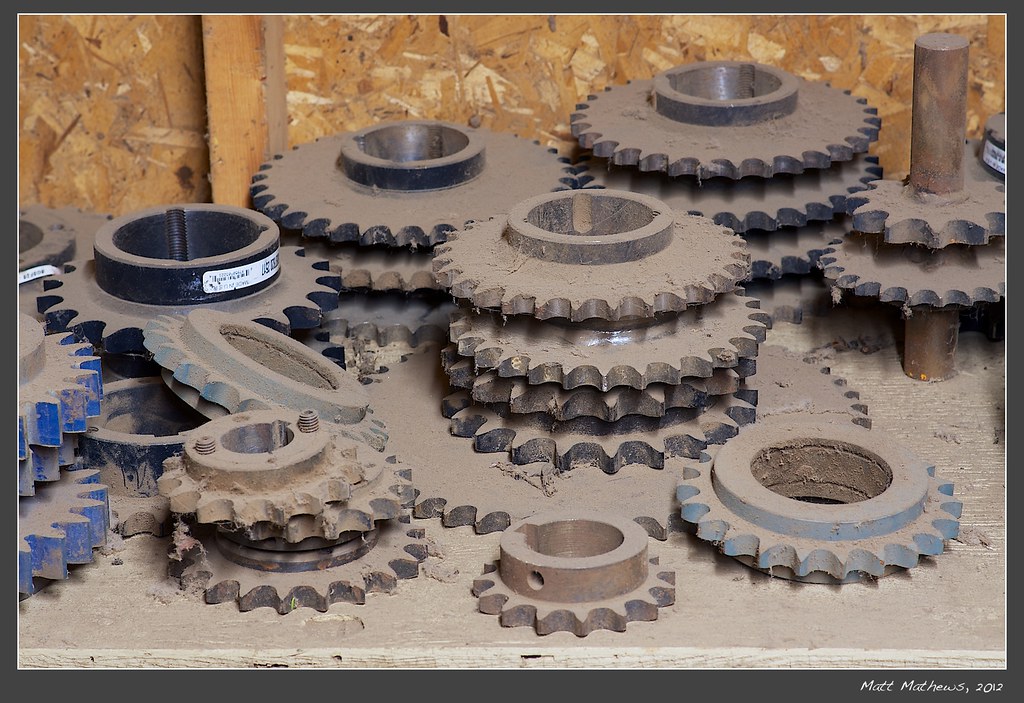
In addition to being loud, the gin building is dusty and filled with ever-accumulating stray lint. The lint clings to everything. Workers routinely sweep the floors, and each day there is down time during which the motors and equipment are cleaned to prevent overheating. Here are a few photos of the lint and spare machinery parts that keep these gins going.




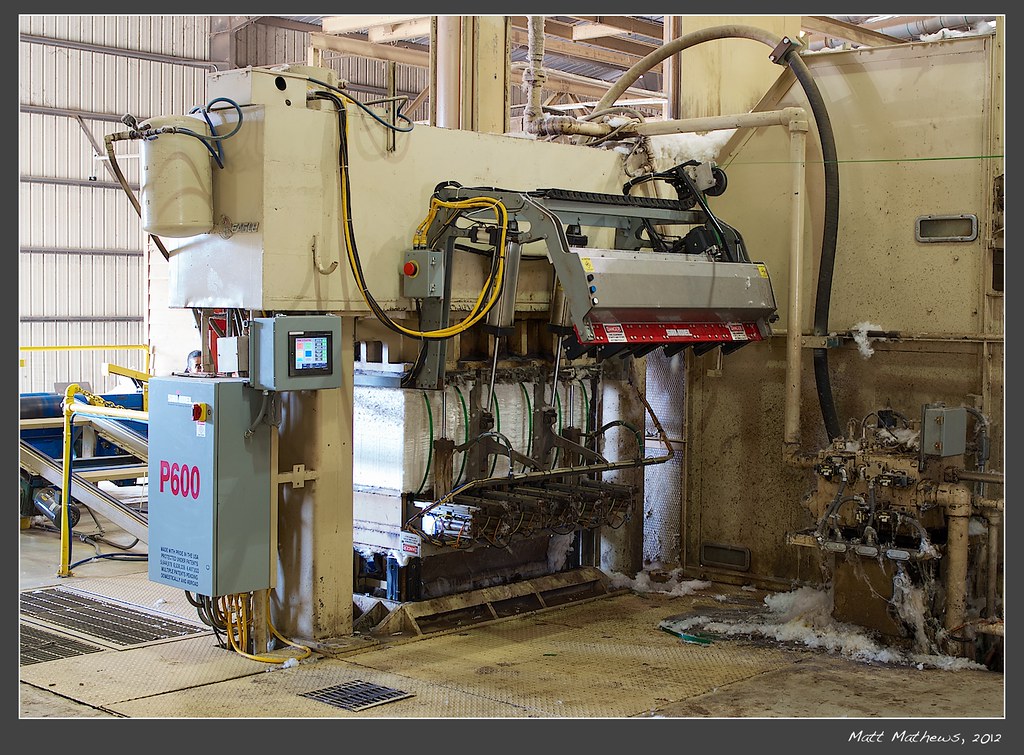
After the cotton passes through various machines where it is seeded and cleaned, it proceeds to this machine where it is compressed into bales, strapped, and flipped onto a conveyor belt for packaging and transportation to the warehouse next door.


As the bale comes out of the press, it is packaged in plastic for protection and a barcode label is affixed. Just prior to packaging it, a worker takes a “core,” which is a small sample swatch from each bale. This sample will be used to grade the quality of the cotton. The US Dept. of Agriculture in Memphis, Tennessee conducts a testing and assessment on each sample and grades it on a three-tiered standard. The price of the content is partly dependent on what grade it receives.

Once packaged, each bale is sent by conveyor belt out of the gin building to a warehouse where it will be stored or loaded onto trucks for distribution. Each bale weighs 480 lbs and contains enough cotton to produce about 325 pairs of blue jeans. The vast majority of cotton produced at this gin will be shipped by truck or rail to the Mississippi River about twenty miles away. It will then be loaded on barges and taken down the Mississippi to the Port of New Orleans (or other gulf ports) where it will be loaded on large ocean-going ships destined for China. It will likely come back to us as goods imported from China. Welcome to the global economy!

Bales that do not meet the standards for the lowest grade are not fit for most manufacturing. However, they are sold for some uses such as to provide stuffing for children’s stuffed animals. These two photos show bales of this low-grade cotton. Note the “No Smoking” sign; more on that later.
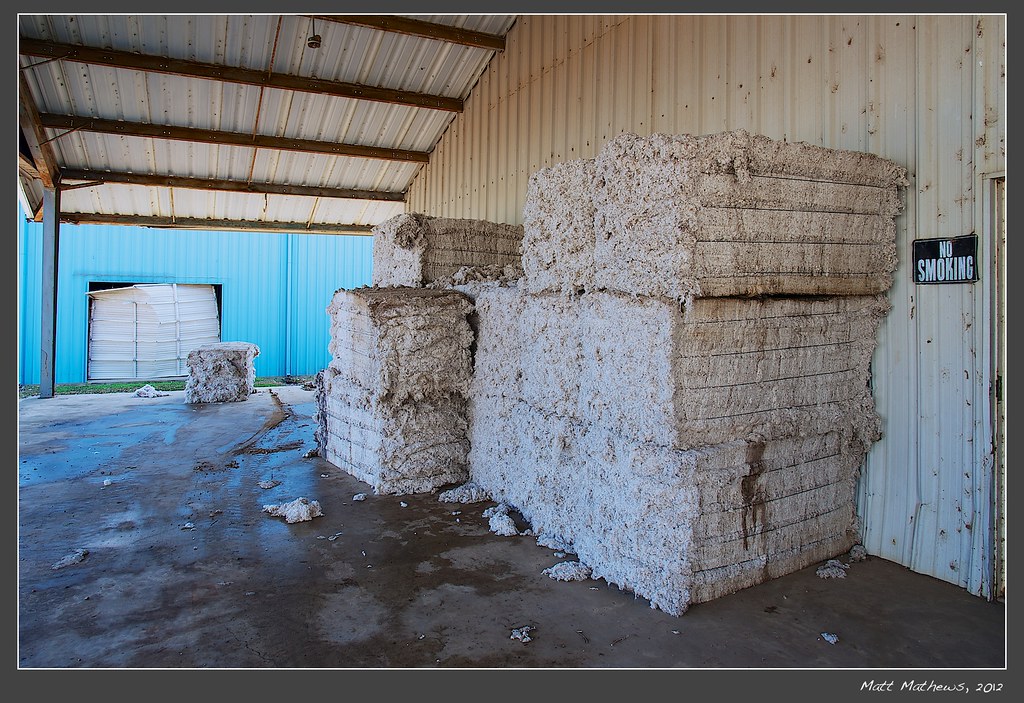
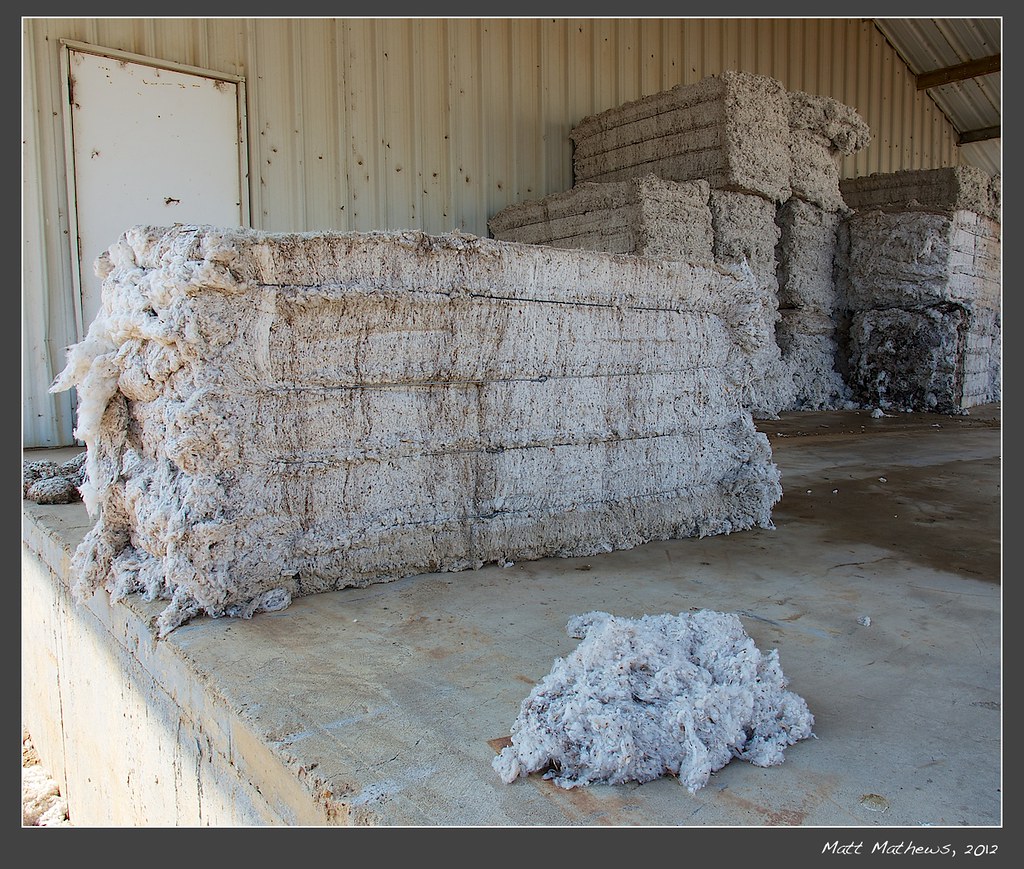
Fire is an ever-present concern in gins because the fiber is very flammable and the vacuum system moves a lot of air through the facilities, thus potentially spreading the fire very quickly. Occasionally bales become so hot inside from a combination of compression and accumulated heat that they spontaneously combust. Before flames appear, smoke begins to come from the bale. If this occurs, the bale is quickly separated from all others, and the fire department is called. Fire crews insert a large metal needle-like device into the burning bale and inject kerosene. There is so little air inside the bale that the kerosene smothers the fire and then evaporates, leaving much of the cotton unharmed.
Here’s one of the buildings where the cottonseed is stored. It is transported by conveyor belt for about 150 yards from the gin building to the seed warehouse. The shape of the seed-storage buildings is designed to conform to how seed tends to settle when piled high.

Nothing is wasted in the ginning process. In this photo (shown earlier), notice the pipe running across the frame. This pipe carries organic debris such as leaves, twigs, and bole fragments to a large outdoor workstation where it is composted and prepared as fertilizer that will be applied to the fields at the next planting.
So, there you have it. More on cotton that you may care to know. I hope you enjoyed this little field trip.
Matt


